
Towson Previous Residents by Era
A single Towson address leaves footprints in several record systems, and each one answers a different question about who lived there. Land records track legal ownership. Directories and telephone books place a subscriber or household at an address. Census schedules describe a household at one moment. Maps and permits describe the building itself. Start with the newest dependable property identity, then move into the era in question, remembering that an omission in one source is not proof a house stood empty. A blank entry proves nothing.
| Historical source | Years it reaches | Where to consult it | What it can add |
|---|---|---|---|
| Baltimore County land records | Surviving series 1659-1851; circuit records from 1851 | MDLandRec, Maryland State Archives, and clerk | Ownership chain, legal description, liens, plats, and transfers |
| Towson and county directories | Towson 1895-1898; county directory 1899; Polk suburban volumes 1898-1899 | FamilySearch or ACPL catalogs, BCPL, and Maryland State Archives | Name, post-office address, and possible occupant or business clue |
| Telephone and white pages | Listed runs from 1941 through 1965, with gaps | Library of Congress and regional libraries | Subscriber and address clue, with unlisted-number limits |
| Federal census | 1790-1950 public schedules | NARA, Census, BCPL, and FamilySearch | Historical household names, ages, relationships, and geography |
| Sanborn and permits | Sanborn collection 1885-1963; permit GIS 1995 forward | Maryland Archives, Library of Congress, and Baltimore County GIS | Building, lot, work, and address continuity clues |
Match the tool to the era. For the newest transfer, SDAT supplies the account and deed reference. A directory answers an 1890s household fastest. For an older building question, pull the land description and a map first, since a changed street label can otherwise create a false match.
Freeze a Towson Address Identity
Freeze the parcel identity before chasing names. SDAT lists the assessed owner, the situs address, and the mailing address. It also shows the account number, sales data, and the map, grid, and parcel references. The situs is the physical property. The mailing address is only where the tax bill goes. Neither field tells you who actually occupied the house. Baltimore County GIS adds parcel geometry, subdivision, plat, ZIP, zoning, and district layers. Use it to confirm the SDAT account really describes the lot you intend.
Keep the account, map/grid/parcel, and plat together in one set of notes. Add the block, lot, book, folio, and latest deed reference to the same set. Street numbers change. A house may carry an older number. It may also carry a different postal place name across the decades. When a parcel has changed shape or an address search dead-ends, the legal description holds up far better. The subdivision references hold up just as well.
Note: A tax mailing address is a lead to the recorded owner, not proof that owner ever occupied the Towson property.
Follow Towson Previous Residents Through Deeds
The Baltimore County deed chain starts with the current SDAT owner and the newest deed or liber/page reference. In MDLandRec, select Baltimore County. Pick the active or historical index for the period, then open the deed image. Read the whole legal description. Work through the prior-deed recital before stepping back to the earlier transfer, and remember the chain names recorded owners, not every person who ever lived at the address.
- Search SDAT for the current address, then record the owner, account, parcel references, and latest deed reference.
- Sign in to MDLandRec, select Baltimore County, and locate the current owner's acquisition in the right index.
- Record the grantor, grantee, instrument type, recording date, liber/page, consideration, legal description, and any statement that identifies the same land.
- Search the seller from that deed as a grantee to find the seller's own earlier purchase. Check name variants, spouses, and trust names.
- Repeat backward. When the online path stops, use the Archives' grantor/grantee index series, microfilm, courthouse, or Archives staff rather than guessing from an address.
- Grantor
- The person or entity transferring an interest in the property, often the seller in a deed.
- Grantee
- The person or entity receiving an interest, often the buyer. Searching an earlier owner as grantee can reveal that owner's purchase.
- Chain of title
- The documented sequence of recorded transfers for the same land or parcel.
- Legal description
- The lot, block, plat, metes, bounds, or other recorded land description. It is usually more reliable than an old street label.
Towson's Long Baltimore County Land Trail
Baltimore County's land trail runs deep. Surviving county court land records reach back to 1659. Land-record and grantor/grantee index series extend into the colonial period, and circuit-court land series begin in 1851. Deeds and mortgages are only the start. The older record universe also holds releases, leases, easements, powers of attorney, bills of sale, manumissions, and certificates of freedom. A modern parcel search cannot replace that archival context. For a Towson deed chain that runs past the active online index, the Maryland State Archives Baltimore County series list is the documented fallback.
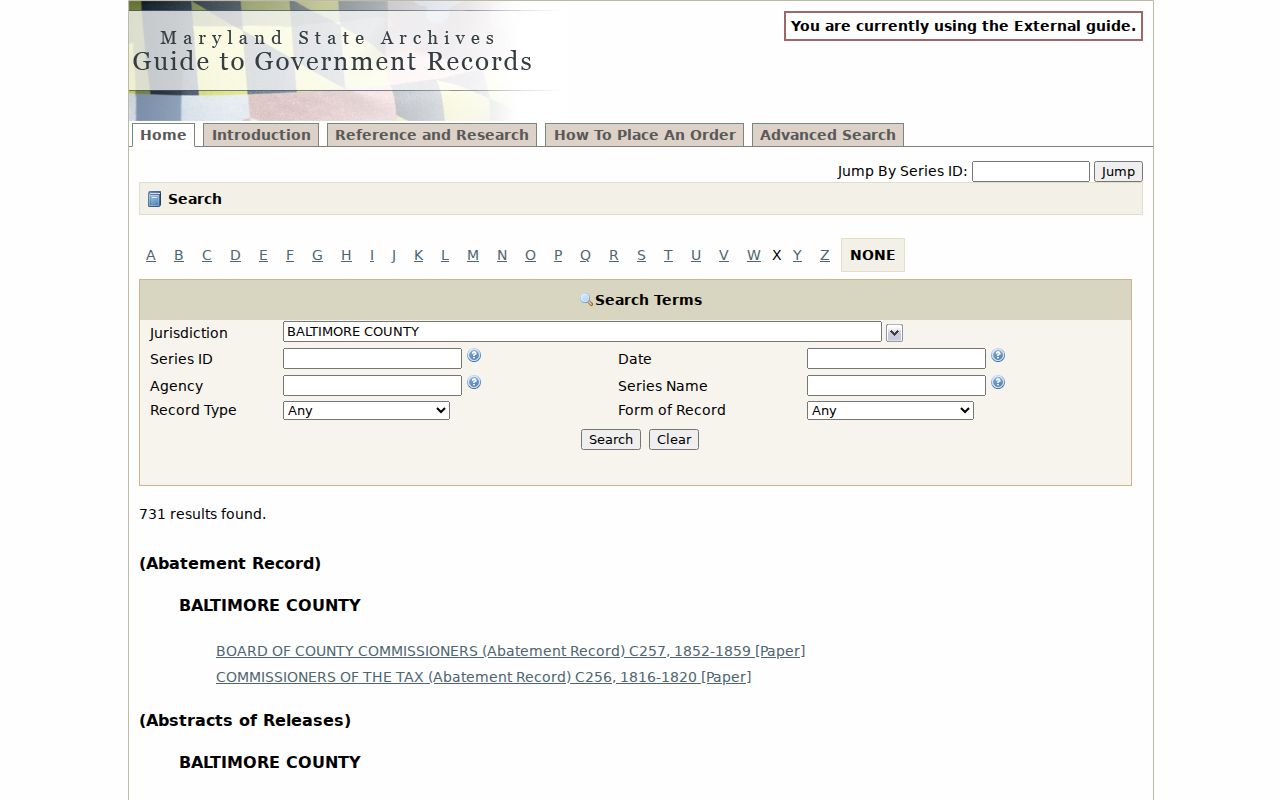
Use the series list before you go. It identifies the historical index or land-book route ahead of a visit or research request.
Check online availability after selecting Baltimore County in MDLandRec. The Baltimore County and Towson chronology explains the records geography behind the trail.
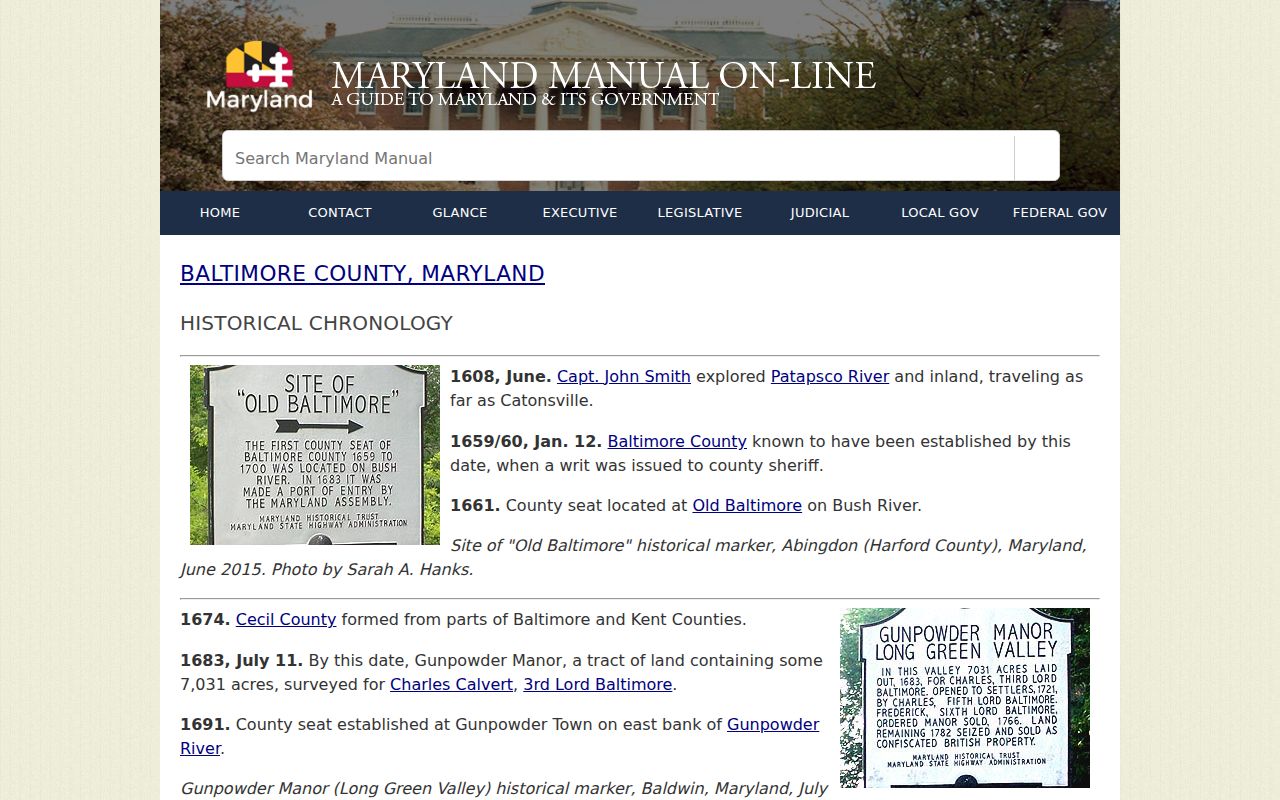
Boundaries matter here. Baltimore City split from Baltimore County in 1851, Towson became county seat in 1854, and the new courthouse opened in 1857. The wrong choice creates a false negative, even when the physical property never moved.
Towson Deed Copies: Screen or Counter
Two routes lead to a Towson deed record. MDLandRec, with a free account, supplies non-certified images wherever a record has been digitized. Certified legal copies follow the Maryland Courts and clerk order process, or a counter visit. The Baltimore County Circuit Court Clerk's Land Records Indexing & Recording Division answers at 410-887-5503; the clerk's general number is 410-887-2601. Know which version you need. A past-residents search often only needs an image, while an estate or title matter demands the official copy.
Historical household research splits the same way. BCPL offers public computers, reference help, librarian appointments, and in-branch Ancestry Library Edition. The Historical Society of Baltimore County holds noncirculating maps, photographs, surname files, cemetery inscriptions, directories, and other local-history material. Nonmembers pay $10 per visit; mail research runs $25 per hour for nonmembers and $15 per hour for members. Turn to the library or the society when the online index or digitized image does not cover the era you need.
Place Towson Previous Residents in Directory Years
Once the deed trail yields an owner or an era, shift to the household layer. Towson directories are listed for 1895 through 1898. The Baltimore County Directory is listed for 1899. Polk's Baltimore City Directory covered suburban towns, including Towson, in 1898 and 1899. Later, telephone and white-page runs supply address-to-subscriber clues. These were irregular commercial publications, not government enumerations, so a missing entry may reflect a skipped canvass, an unlisted number, a lodging arrangement, or a boundary choice.
- Normalize the address with its current situs, any old number or street form, lot/block or subdivision detail, and postal-place variation.
- Search an address or criss-cross section first when it exists, then search the surname section. Write down initials, spelling variants, and every household name shown.
- Compare the next available volume before concluding that a household moved. Towson's listed runs are not annual across every era.
- Pair nearby directory evidence with the 1900, 1910, 1920, 1930, 1940, or 1950 federal census, whichever historical date fits the trail.
- Use a deed for legal ownership and the census or directory for a historical household clue. Then test a move, death, or heir relationship with newspapers, probate, cemetery, or vital-index evidence.
Learn the key before you lean on a directory year. A typical entry carries a name, a spouse or household note, an occupation, a street number and street, and a mark showing whether the person owned the place. Guessing at abbreviations will steer you wrong. Read the volume's front matter first, since that is where the publisher explains its own shorthand, and see the Towson City Directory page for a fuller description of these collections.
Test a Towson Address With Maps
Sanborn maps settle a building question, not a residency one. The Maryland collection spans 1885 through 1963. It lists Towson among its towns. The index does not itemize Towson's exact sheet years, so you may have to browse. Once a sheet is in hand, weigh its footprint, construction material, use, lot context, and road label. Match those details against the legal description and the directory address. A map proves a building stood there or that the street once ran differently. It cannot name who lived inside.
Baltimore County's public GIS permit layer helps with later changes. It states coverage from 1995 forward for pre-2022 permits. The layer exposes application, issue, and occupancy dates. It also lists owner and site-address fields, work description, ZIP, plat, block, lot, map, grid, and parcel fields. Treat those dates as evidence, not proof of occupancy. The companion Accela search needs an account. It warns that results cover only permits submitted by the user or creator. Older detail may call for a county request or a visit to the counter.
Note: A permit applicant or owner field can go stale and never lists every past resident.
Towson Previous Residents and Old Labels
One property can wear several labels. Effective January 14, 2012, a USPS Postal Bulletin changed the preferred last-line place name for ZIP 21284 from Loch Raven to Towson. It made the same change for ZIP 21285, swapping Baltimore for Towson. The ZIP numbers themselves stayed put. So an old record may read Baltimore, Loch Raven, Towson, or a suburban edition. Each label points at the same general geography. Expect that drift in any resident lookup across directory decades.
The official street number can differ too. An owner may use a number the county does not recognize. SDAT advises trying its full street-name syntax. Drop directional prefixes and suffix abbreviations. Then try a truncated street name with an asterisk. Baltimore County's Towson Community Plan notes an old street number for 1213 West Joppa. However, no official countywide Towson renumbering table exists. Treat a former number as a lead only. Verify it against the parcel, plat, and legal description before you trust it.
Historic East Towson Resident Sources
A Towson house history should reach past the mainstream directories. Historic East Towson is the oldest African-American community in Baltimore County. Its households appear in sources that a printed city directory may miss entirely. Towson University's Unearthing Towson's History Project and the Northeast Towson Improvement Association can correct gaps or labels in a directory search. So can local churches, cemetery records, oral histories, schools, and newspapers. That difference matters. It is a reason to widen the source path. It is not a reason to flatten the community into a generic neighborhood entry. The Towson University Unearthing Towson's History project supplies local historical context. It serves research that must go beyond a printed directory.

Pair the project with other local holdings. Historical Society of Baltimore County material, BCPL's in-branch genealogy tools, parish or cemetery records, and the local newspaper chain often catch a household that a mainstream list leaves out.
Towson Past Households and Endpoints
A previous-residents search usually ends at an endpoint. Towson News ran from 1905 to 1909. The merged Baltimore County Union followed, from 1909 to 1912. The Towson News filled the gap between them. Union News continued after 1912 to 1959. A newspaper can hand you an announcement. It may carry an estate notice, legal notice, death notice, business name, or address clue. Use those as leads. Then verify relationship, property, and date details with probate, vital, cemetery, or recorded land evidence.
The Baltimore County Register of Wills holds estate proceedings. It also keeps inventories, accounts, letters, heirs, and estate correspondence. The office sits at 401 Bosley Avenue, Room 500. It is separate from the circuit clerk. Estate Search runs through Maryland Courts access pages. Copies go through the Records Division or the counter. Older death and genealogical material may instead sit with the Maryland Department of Health. The Maryland State Archives and local historical sources also hold material, depending on age and eligibility.
For a current-title worry, the Maryland Insurance Administration deed and title-fraud advisory can help. It tells owners to check deed activity. Owners should also contact the county clerk and law enforcement when a fraudulent deed is suspected.
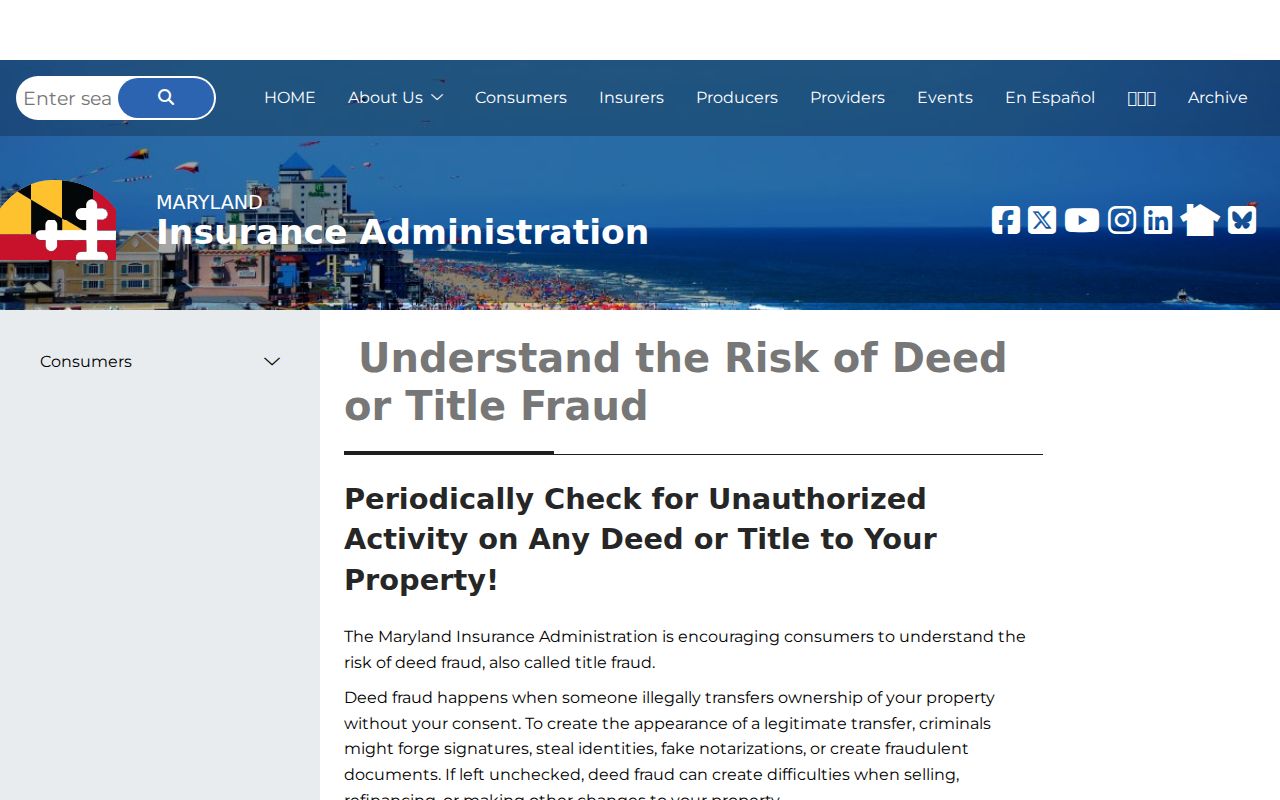
A mail offer for a costly deed profile is not the clerk's office. Check the original SDAT or MDLandRec record, and use the named public custodian for any copy or correction.